Best Placement Tools for Students in 2026
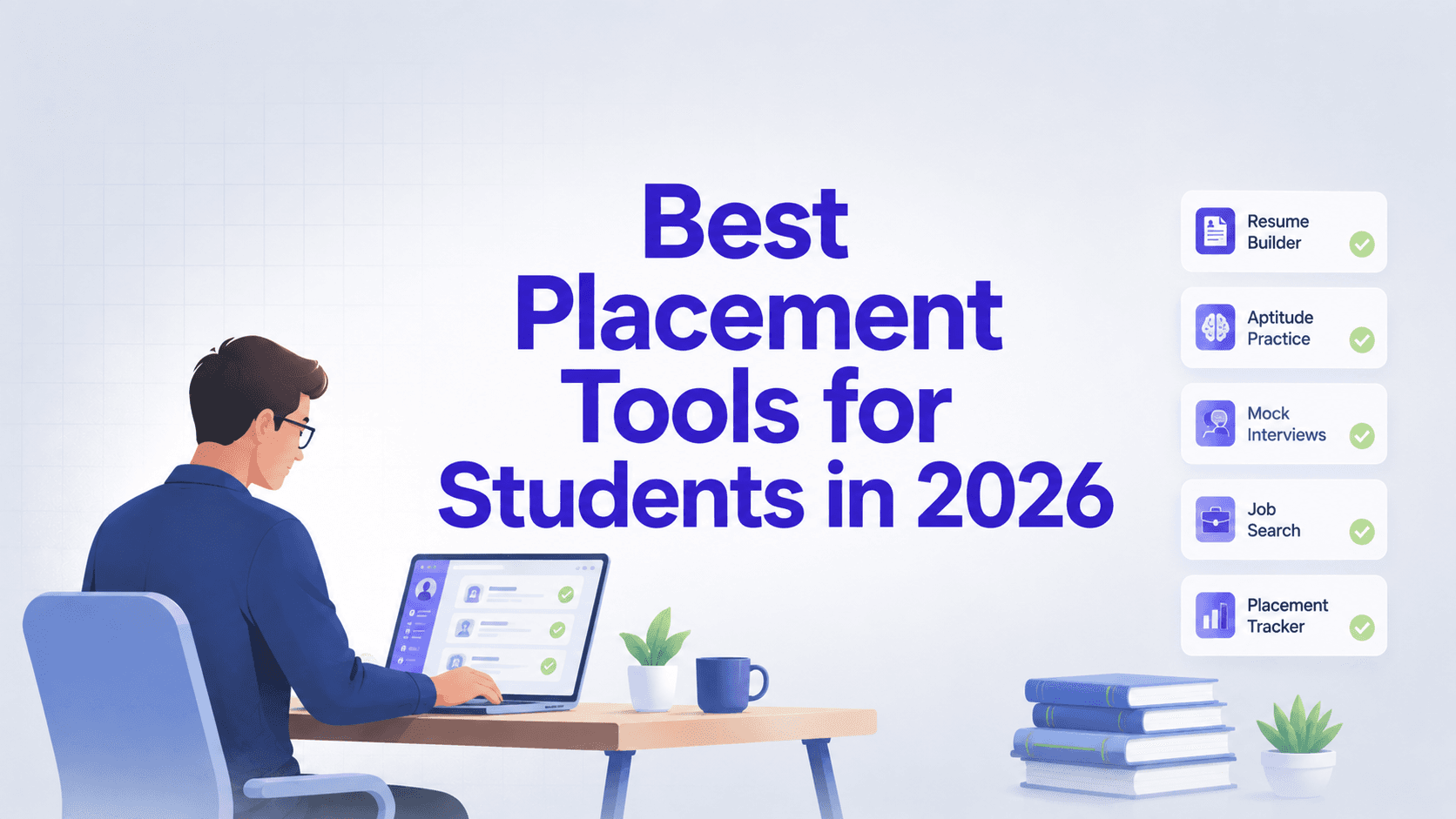
Explore the best placement tools for students in 2026, including aptitude platforms, resume builders, coding websites, and interview preparation tools that improve placement success rates.
Campus placements in 2026 are no longer dependent on academic scores alone. Companies now evaluate students across multiple layers including aptitude performance, resume quality, coding efficiency, communication ability, and interview readiness. This shift has created a new challenge for students because preparation is no longer linear.
Many students spend months preparing without understanding where they are actually weak. Some solve coding questions daily but fail resume screening. Others build strong resumes but struggle during technical interviews. The biggest difference between placed and unplaced students today is often not talent. It is access to the right placement tools and a structured preparation system.
Table of Contents
Which Placement Tools Are Essential for 2026 Freshers?
The hiring funnel for freshers has changed significantly over the last three years. Recruiters now filter thousands of applications using automated systems before a human recruiter even reviews the profile. According to industry hiring reports published across platforms like LinkedIn and Naukri, companies increasingly rely on ATS screening, online assessments, AI monitored interviews, and coding evaluations to reduce recruitment time.
This means students must prepare simultaneously for multiple rounds instead of focusing only on aptitude or coding. A successful placement preparation strategy now requires a complete ecosystem of tools working together.
Core Placement Preparation Categories
- Aptitude preparation platforms
- ATS optimized resume builders
- Coding practice websites
- Mock interview simulators
- Communication improvements
- Placement tracking systems
- AI based learning assistants
For example, a computer science student preparing for product companies typically spends time on coding platforms like LeetCode while also using resume optimization tools to improve ATS compatibility. At the same time, they often struggle with behavioral interview rounds because preparation becomes fragmented across disconnected platforms.
This fragmentation creates placement chaos in colleges as well. TPOs managing hundreds of students often lack visibility into who is actually placement ready. Institutions still using spreadsheets for student tracking face delays in recruiter coordination, assessment scheduling, and hiring analytics.
That is why structured placement ecosystems are becoming increasingly important for both students and institutions. But preparation usually starts with the most ignored layer of placements: resumes.
Top Rated Resume Builders for ATS Friendly Applications
Many students assume recruiters manually review every resume. In reality, ATS software filters resumes before recruiters even see them. Poor formatting, weak keywords, inconsistent structure, and lack of measurable achievements can eliminate a profile instantly.
An ATS friendly resume should not only look professional but also communicate clarity and relevance within seconds. This is where resume optimization tools become critical.
| Tool | Best Use Case | Key Advantage |
|---|---|---|
| Canva Resume Builder | Design focused resumes | Easy customization |
| Overleaf | Technical resumes | Professional LaTeX templates |
| Resume Worded | ATS optimization | Resume scoring insights |
| Enhancv | Freshers and internships | Simple content guidance |
Students often underestimate the importance of resume personalization. A generic resume sent to twenty companies usually performs worse than a targeted resume aligned with a specific job description.
For students struggling with resume quality improvement, tools like Resume Optimizer help identify weak resume sections, missing keywords, and formatting problems that impact ATS visibility.
Students can also learn advanced resume frameworks from resources like:
A strong resume opens the first door. The next challenge is surviving technical screening rounds where coding performance becomes the deciding factor.
Must Use Coding Platforms for Technical Round Mastery
Coding rounds have evolved beyond simple syntax questions. Recruiters now test problem solving depth, optimization ability, debugging logic, and communication during live coding sessions.
Students preparing for placements in companies like Amazon, Infosys, TCS Digital, Accenture, and product startups need a structured coding roadmap instead of random question solving.
Step by Step Coding Preparation Framework
- 1 Master one programming language thoroughly
- 2 Practice aptitude alongside coding daily
- 3 Focus on arrays, strings, recursion, and trees
- 4 Solve timed company specific problems
- 5 Participate in mock contests weekly
- 6 Review failed solutions systematically
- 7 Practice explaining code verbally
The best coding tools for placement preparation in 2026 include:
- LeetCode for interview style questions
- Codeforces for competitive programming
- HackerRank for beginner to intermediate
- GeeksforGeeks for concept explanations
- InterviewBit for structured tracks
One common issue students face during coding preparation is understanding complex solutions after solving failures. Instead of simply memorizing answers, concept based learning improves retention significantly.
AI assisted tools like Code Explainer and Feynman help students simplify difficult concepts into understandable explanations, improving long term coding confidence.
Still, technical knowledge alone does not guarantee offers. Many students fail during interviews despite strong coding skills because they never practiced under real pressure conditions.
How Do Mock Platforms Improve Your Interview Readiness?
Interview anxiety remains one of the biggest placement barriers for freshers. Students who perform well during preparation often struggle during actual interviews because they are unfamiliar with recruiter expectations, communication flow, and pressure handling.
Mock interview platforms simulate realistic hiring environments. They help students improve communication clarity, confidence, technical articulation, and behavioral storytelling.
Platforms like Pramp, Interviewing.io, and Final Round AI have gained popularity because they expose students to real time interview experiences. This exposure improves response structuring and reduces nervousness during final rounds.
Consider a typical placement scenario in engineering colleges. A student clears aptitude and coding rounds but fails HR interviews repeatedly because answers sound robotic. Mock practice helps identify these communication gaps early.
This is also where placement analytics become important for institutions. Colleges increasingly need systems that track student preparation progress, interview performance, recruiter engagement, and hiring funnel conversion rates.
Without structured tracking, TPOs often struggle to identify which students are placement ready and which require intervention. As recruiter expectations rise, placement management itself is becoming a technology driven process.
The final step is combining all these tools into one consistent preparation ecosystem instead of using disconnected resources randomly.
Build Your Ultimate Placement Preparation Tech Stack
The highest performing students rarely rely on a single platform. They build a structured placement preparation stack aligned with hiring stages.
A practical 2026 placement tech stack usually looks like this:
- Resume optimization for ATS visibility
- Aptitude platforms for screening rounds
- Coding practice for technical filtering
- Mock interview tools for readiness
- Placement tracking for progress visibility
- Analytics dashboards to find weaknesses
The biggest realization students and colleges face eventually is this: unstructured preparation creates inconsistent results. Students often prepare hard but not strategically. Colleges conduct drives but lack centralized visibility into outcomes, recruiter coordination, and student readiness.
This is why structured placement ecosystems are becoming the logical evolution of campus recruitment operations. Platforms that centralize preparation, student tracking, and hiring workflows reduce chaos while improving placement outcomes systematically.
Conclusion
The best placement tools in 2026 are not just productivity apps. They are decision making systems that help students prepare smarter, identify weaknesses earlier, and improve placement outcomes consistently. Students who combine resume optimization, coding practice, aptitude preparation, and mock interviews into one structured workflow gain a measurable advantage during campus recruitment. Institutions that support this structured approach also improve recruiter trust, hiring efficiency, and placement analytics. If you want to improve your placement preparation systematically, explore advanced learning tools, practical workflows, and placement focused resources that simplify the entire journey from preparation to hiring readiness.
FAQ
1. Which is the best placement preparation tool for freshers?
There is no single tool that covers every placement stage effectively. Students usually need a combination of aptitude platforms, coding websites, resume optimization tools, and mock interview systems to prepare comprehensively.
2. How important is ATS optimization for placements?
ATS optimization is extremely important because many recruiters use automated screening systems before reviewing resumes manually. Poor formatting and weak keywords can lead to rejection even before interviews begin.
3. Which coding platform is best for campus placements?
LeetCode, HackerRank, and InterviewBit remain among the most effective coding platforms for placement preparation because they provide company specific practice questions and structured learning paths.
4. Are mock interviews necessary for placements?
Yes. Mock interviews improve communication, confidence, problem solving articulation, and pressure handling. Many students fail interviews due to nervousness rather than lack of technical knowledge.
5. How can colleges improve placement management?
Colleges can improve placement outcomes through centralized student tracking, recruiter coordination systems, placement analytics, and structured preparation workflows instead of relying on spreadsheets and manual processes.
6. How much time should students spend daily on placement preparation?
Most successful students follow a consistent preparation schedule of 2 to 4 focused hours daily, balancing aptitude, coding, resume improvement, and interview preparation together.