How to Prepare for Technical Interviews at MNCs
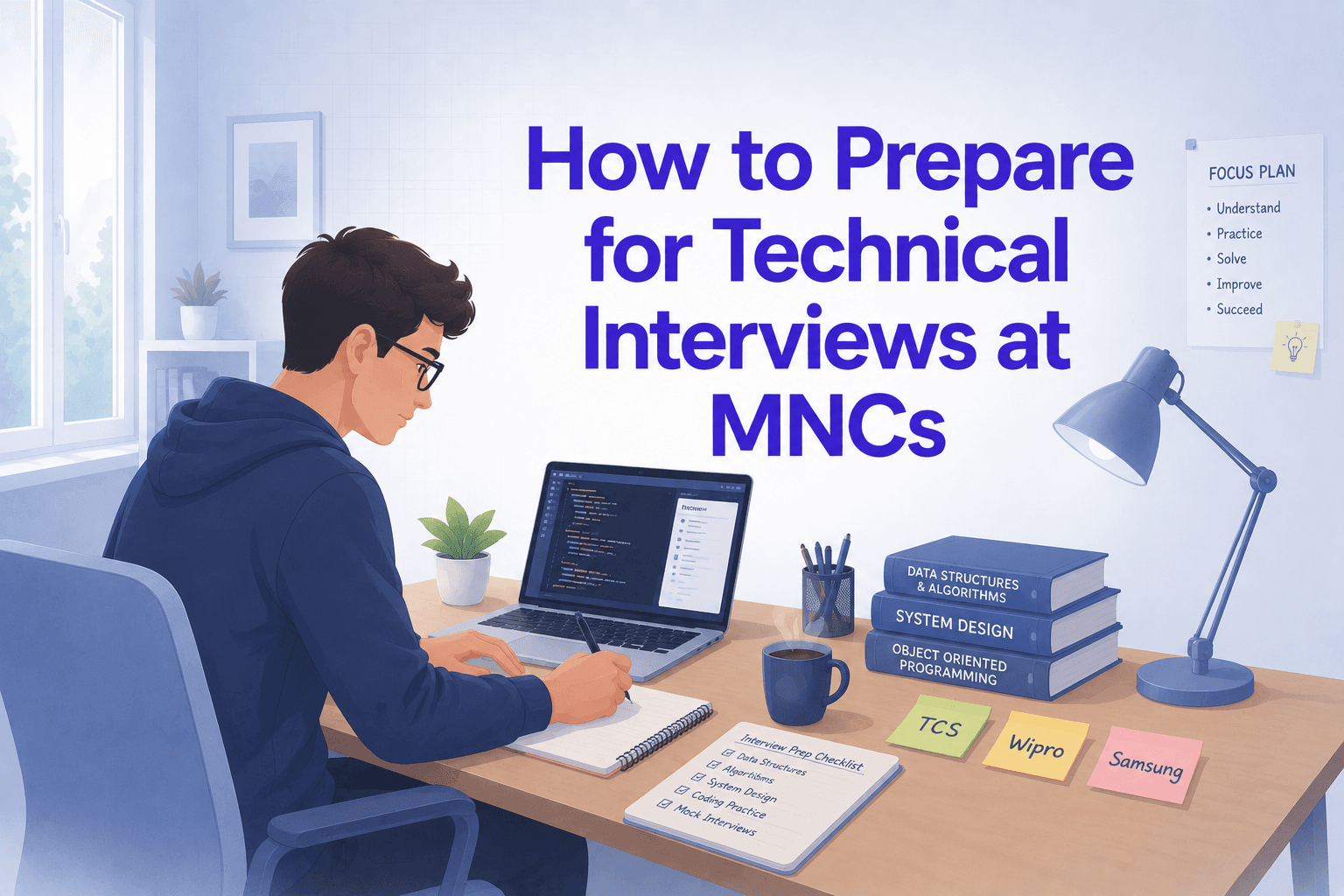
Preparing for technical interviews at MNCs? Learn coding fundamentals, system design basics, behavioral interview strategies, and proven frameworks to improve interview performance.
Introduction
Technical interviews are often the most decisive stage of the hiring process at multinational companies. While resumes and academic achievements help candidates reach the interview stage, technical rounds determine whether they can actually solve problems, communicate effectively, and contribute to real-world projects. As competition for top technology roles continues to increase, candidates need a structured preparation strategy rather than relying on last-minute revision.
From an HR perspective, the candidates who consistently succeed in technical interviews are rarely the ones who memorize the most answers. Instead, they are individuals who understand fundamentals, communicate their thought process clearly, and demonstrate the ability to learn quickly. Whether you are targeting software engineering, cloud computing, cybersecurity, analytics, or technology consulting roles, understanding how technical interviews work can dramatically improve your chances of success.
Table of Contents
- How Do MNCs Structure Technical Interviews in 2026?
- Essential Coding and Data Structure Fundamentals
- Proven Frameworks to Solve Complex Technical Problems
- How Do You Master System Design and Domain Knowledge?
- Behavioral Interview Hacks: Using the STAR Method
- How to Build Your Professional Mock Interview Routine
- Conclusion
- FAQ
How Do MNCs Structure Technical Interviews in 2026?
Technical interviews at MNCs have evolved significantly. Companies no longer assess candidates solely through coding questions. Instead, recruiters evaluate problem-solving ability, communication skills, project understanding, and technical decision-making. Most hiring processes begin with an online assessment followed by multiple interview rounds.
Before entering technical rounds, candidates should build a strong foundation through structured placement preparation tools that help improve aptitude, coding, and interview readiness. Many recruiters also recommend consistent practice on LeetCode because it closely reflects the style of questions used by many technology companies.
| Interview Stage | Primary Evaluation Area |
|---|---|
| Online Assessment | Coding, aptitude, logical reasoning |
| Technical Round | Programming and debugging |
| System Design | Architecture and scalability |
| Behavioral Round | Communication and teamwork |
| Managerial Round | Role fit & long-term potential |
Understanding this structure allows candidates to prepare strategically rather than studying random topics. The strongest foundation for success remains coding and data structure knowledge.
Essential Coding and Data Structure Fundamentals
Coding assessments remain one of the most common filters used by MNCs. Recruiters use programming challenges to evaluate logic, analytical thinking, and code quality. Candidates who understand concepts deeply often perform better than those who simply memorize solutions.
Topics such as arrays, strings, linked lists, stacks, queues, trees, graphs, sorting algorithms, recursion, and dynamic programming continue to dominate technical interviews. These topics appear repeatedly because they help interviewers understand how efficiently candidates solve problems.
To improve coding performance, candidates should regularly practice on platforms such as GeeksforGeeks while also exploring our guide to the best coding platforms for interview preparation.
A common mistake among candidates is focusing only on finding the correct solution. Interviewers are equally interested in understanding why a particular solution was chosen. This is where time complexity and space complexity analysis become important.
For example, if two candidates solve the same problem correctly but only one can explain optimization opportunities and performance trade-offs, that candidate typically creates a stronger impression. Technical interviews reward understanding, not memorization. Coding knowledge alone is rarely enough. Complex interviews often require structured approaches to solving unfamiliar challenges.
Proven Frameworks to Solve Complex Technical Problems
One of the biggest differences between average and exceptional candidates is the way they approach problems. Interviewers are not simply evaluating answers. They are evaluating thinking patterns. A highly effective framework is the Understand, Analyze, Plan, Execute, and Optimize model. This approach prevents candidates from rushing into solutions without considering requirements and constraints.
The UAPEO Framework
- U Understand: Clarify the requirements.
- A Analyze: Break the problem into smaller parts.
- P Plan: Discuss possible approaches.
- E Execute: Implement the solution.
- O Optimize: Improve efficiency and scalability.
Many candidates improve dramatically after learning structured problem-solving techniques. Candidates preparing for technical rounds should also review the skills recruiters look for because interviewers often assess both technical expertise and problem-solving behavior.
For broader learning paths and role-specific technology roadmaps, resources like roadmap.sh can help candidates understand what skills are expected for different engineering roles.
As technical interviews become more sophisticated, recruiters increasingly evaluate architectural thinking and domain expertise.
How Do You Master System Design and Domain Knowledge?
System design discussions are becoming increasingly common, even for early-career roles. Recruiters want to understand how candidates think about scalability, reliability, security, and performance. Candidates should understand concepts such as APIs, databases, caching, authentication, cloud infrastructure, and microservices. You do not need to design enterprise-scale systems, but you should understand how modern applications function.
One effective approach is studying real-world products. Consider how food delivery applications process orders or how streaming platforms deliver content to millions of users. These examples help develop architectural thinking and make technical discussions more practical.
Candidates should also focus on strengthening project discussions. Before interviews, ensure your resume highlights projects effectively by following guidance from our article on creating an ATS-friendly resume.
To strengthen technical depth further, candidates can supplement their learning through specialized courses available on Coursera. These programs often provide structured learning paths for cloud computing, software engineering, data science, and cybersecurity. Technical expertise can help candidates reach final rounds, but behavioral interviews frequently influence hiring decisions.
Behavioral Interview Hacks: Using the STAR Method
Many technically strong candidates lose opportunities because they struggle during behavioral interviews. Recruiters use behavioral questions to assess teamwork, leadership, communication, adaptability, and conflict management. The STAR Method remains one of the most effective frameworks for answering these questions.
STAR Framework
- Situation: Explain the context.
- Task: Describe your responsibility.
- Action: Explain the actions you took.
- Result: Share measurable outcomes.
For example, when discussing project challenges, avoid vague answers. Instead, explain the situation, your role, the actions you took, and the final outcome. Structured answers help recruiters understand your contribution more clearly.
Candidates who struggle with communication often benefit from reviewing common interview mistakes and practicing responses repeatedly. Confidence develops through preparation rather than luck. The final step is creating a professional interview practice routine.
How to Build Your Professional Mock Interview Routine
Mock interviews are one of the most effective preparation tools available. Unfortunately, many candidates spend hundreds of hours studying technical concepts but very little time simulating actual interviews. A professional mock interview routine should include coding challenges, technical discussions, project reviews, and behavioral questions. Consistent practice improves communication and reduces anxiety.
Schedule at least two mock interviews each week. One should focus on technical topics, while the second should focus on communication and project discussions. Recording sessions can reveal improvement opportunities that are often missed during live practice.
Candidates preparing for campus recruitment can further strengthen readiness by reviewing our complete guide on campus placement preparation. Combining technical preparation with interview practice creates a much stronger overall profile.
Peer interviews can also be highly effective. Practicing with friends introduces unpredictability and encourages more natural responses. Over time, this builds confidence and improves interview performance. The objective is not perfection. The objective is familiarity. Candidates who repeatedly simulate interview conditions often appear more composed and confident during actual recruitment processes.
Conclusion
Technical interviews at MNCs require more than strong coding skills. Recruiters evaluate problem-solving ability, communication, system thinking, project understanding, and professional behavior throughout the hiring process. Candidates who master coding fundamentals, use structured problem-solving frameworks, understand system design concepts, prepare behavioral answers using the STAR Method, and practice through mock interviews consistently outperform those who rely solely on technical preparation. With the right strategy and disciplined effort, technical interviews become an opportunity to showcase your capabilities and stand out from the competition.
FAQ
How should I prepare for technical interviews at MNCs?
Focus on coding fundamentals, data structures, algorithms, system design basics, behavioral interview preparation, and regular mock interviews.
What coding topics are most commonly asked in technical interviews?
Arrays, strings, linked lists, trees, graphs, recursion, sorting algorithms, and dynamic programming are among the most frequently tested topics.
Do freshers need system design knowledge?
Yes. While advanced architecture is not usually expected, understanding basic system design concepts can significantly improve interview performance.
What is the STAR Method?
The STAR Method is a structured framework for answering behavioral questions using Situation, Task, Action, and Result.
How many mock interviews should I take?
Most candidates benefit from five to ten mock interviews covering technical, behavioral, and project-based discussions.
How long should I prepare for technical interviews?
Most candidates require two to six months of focused preparation depending on their current skill level and target role.